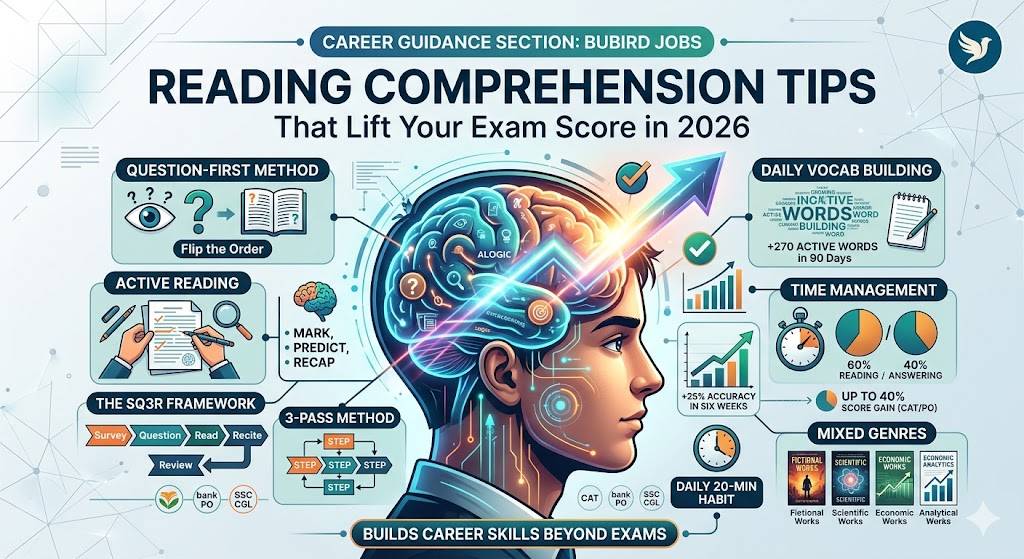
## What Reading Comprehension Really Means
Reading comprehension is the skill of grasping, recalling, and using ideas in any text you face. It isn't about how fast your eyes move down the page. It's about reading with a clear purpose and knowing what to skip. For Indian freshers and working pros, this skill shapes exam results, interviews, and daily work output.
You'll meet this skill in many forms across your career. The CAT verbal section tests it, the bank PO paper tests it, and campus aptitude rounds test it too. Even your daily emails and client briefs check the same muscle without warning. Strong comprehension skills carry you from your first placement test to your boardroom years.
> Fresher Example: A campus drive gives you four passages in 20 minutes, and you can't slow down. So you need a clear, repeatable method from day one of your prep.
> Experienced Example: A team lead reads a 30-page client brief before a Monday call with stakeholders. The same skim-mark-recap habit applies, just at bigger stakes.
These reading comprehension tips aren't tricks you memorise the night before a test. They're habits you build over a few focused weeks. The best part is you don't have to read more pages; you just have to read each page better by deploying proven active reading techniques.
---
Why Most Test-Takers Fail at Comprehension
Most candidates lose marks because they read without a goal in mind. They open the passage and start scanning from line one, hoping the meaning will sink in automatically. It rarely does under timer pressure, and accuracy slips below 50% on tough sets. The right habits fix this gap inside two weeks of steady practice.
According to a 2026 NASSCOM IT hiring report, weak comprehension is the top reason freshers fail client tests at major firms like TCS, Infosys, and Accenture. Strong comprehension skills now feature in dedicated hiring rounds across IT services and BFSI roles because code documentation and client design specifications demand flawless text analysis.
### Three Habits That Wreck Your Score
- 1**Reading the passage before the questions:** You burn four minutes on a 600-word block before you even look at what is being asked. Then you have to scan the passage all over again to find each answer. That is wasted time on any clock-bound test.
- 2**Hunting for exact word matches in the options:** Test setters paraphrase on purpose to filter out lazy readers. If the passage says *"rising temperatures,"* the right option might say *"climate warming."* Chasing literal words costs you marks.
- 3**Falling for the partly-true trap in answer choices:** Wrong options are rarely fully wrong; they often mix one true fact from the text with an unstated or false claim. Your brain locks onto the true phrase and ticks the box without verifying the rest of the clause.
### What Recruiters Check in Comprehension Rounds
When designing these rounds for entry-level and professional hires, recruiters systematically test five core sub-skills:
* Inference: Can you draw the logical conclusion the passage hints at without stating it directly?
* Tone: Can you tell if the writer is critical, neutral, cynical, or warm in their approach?
* Main Idea: Can you split the central thesis statement from the supporting data and structural filler?
* Word Meaning: Can you accurately guess the definitions of unfamiliar terms using surrounding context clues?
* Structure: Can you track paragraph shifts to identify where specific arguments sit without rereading the full text?
A fresher who masters these five elements clears 80% of aptitude rounds with room to spare. Let's look at how to build these mechanics from scratch.
---
How Do You Apply Reading Comprehension Tips Quickly?
The fastest route to high-level mastery is simple: read one editorial daily, mark three new words, and write a 50-word summary in your own words. Do this for 30 days without a break, and your accuracy will jump by 20 to 30 percent on real mock tests. These reading comprehension tips work for freshers and senior pros alike across most competitive exams.
This deliberate drill builds three skills simultaneously: structural passage analysis, functional vocabulary work, and active recall. You will naturally train your cognitive processing speed without losing your footing on dense text configurations.
### Start With a 20-Minute Daily Routine
Set a fixed slot every day at the same time. A lunch break, your morning train commute, or the hour after dinner all work fine. Consistency of the slot matters far more than the prestige of the source material you pick. Choose one complex editorial piece from *The Hindu*, *The Indian Express*, or *Mint* each morning.
Read it once fully without stopping to look up words, then immediately look back to pull out the three core argumentative lines that hold the piece together. Next, close the tab and write a 50-word recap entirely in your own words. This simple loop trains active recall, which is the foundational muscle behind every major score gain you will unlock.
### Build Your Vocabulary in Five Minutes a Day
Weak vocabulary is a massive hidden cause of poor comprehension under exam pressure. You simply cannot grasp a passage when even five percent of the words feel foreign. Systematic vocabulary building should sit in your day like brushing your teeth—not treated as a painful weekend chore.
* Pick three new words from your daily reading and write them in a dedicated notebook or app.
* Use each new word in your own written sentence or conversation the same day.
* Review yesterday’s three words every single morning before you open a new article.
After 90 days of steady execution, you will have added 270 high-utility words to your active mental stock. That is enough structural vocabulary building to crack most management entrance exams with room to spare. This is the highest-ROI part of your exam preparation, and it pays off across every verbal section of competitive exams.
### Time Yourself From Day One
Untimed practice trains toxic habits that will not survive the high-pressure environment of a real exam hall. Set a strict countdown timer for every passage you attempt, and force yourself to stick to it without looking at the clock mid-sentence.
| Passage Length | Reading Time Allotment | Answering Time Allotment | Total Target Time |
| :--- | :--- | :--- | :--- |
| Short Passages (~400 words) | 4 Minutes | 3 Minutes | 7 Minutes |
| Medium Passages (~800 words) | 7 Minutes | 5 Minutes | 12 Minutes |
| Long Passages (~1,200 words) | 10 Minutes | 7 Minutes | 17 Minutes |
Track your accuracy metrics weekly in a simple spreadsheet. If your score isn't rising by week four, your structural reading style is the core issue, not your practice volume. For highly structured placement practice patterns, check out our comprehensive [career advice guide](/feed/career-guidance-basics) to align your tracking.
---
10 Reading Comprehension Tips That Actually Work
Here are the ten reading comprehension tips that top scorers swear by across competitive environments. They work seamlessly on CAT, GMAT, GRE, Bank PO, AMCAT, and eLitmus tests alike. Each technique is field-tested, so pick three to implement into your drills this week.
### Tip 1: Preview Before You Read
Spend exactly 30 seconds scanning the layout of the passage before doing a deep dive. Read the main title, the first sentence of each paragraph, and the final concluding line of the text. This builds a clean mental map in your brain that new details can neatly slot into as you read along.
### Tip 2: Read the Questions First
Skim through the question stems before you touch the passage text. Note the target keywords or specific paragraph references in each stem on a quick scratch pad. Now, you are reading with a selective hunting mindset. This single tactical shift adds immediate marks to your mock baseline.
### Tip 3: Mark Key Claims as You Go
Underline or mentally tag the single primary claim in each paragraph as you progress. One tag per paragraph is more than enough for any passage. Do not fall into the trap of highlighting half the page; keeping less ink on the page forces sharper attention during your passage analysis.
### Tip 4: Use the SQ3R Method
The SQ3R framework stands for Survey, Question, Read, Recite, and Review. Developed by academic researchers, top training institutes still leverage it globally because it completely rewires how your mind processes long-form print. Each stage of the framework forces active cognitive engagement over passive scanning.
### Tip 5: Recap Every Paragraph in One Line
Pause for three seconds after completing each paragraph and state its core meaning in one short, simple phrase. If you find you cannot manage that, you didn't actually process the text. Go back and re-read that section immediately. This drill is the ultimate fix for zoning out under time constraints.
### Tip 6: Read the Last Paragraph Twice
The final paragraph almost always contains the author's ultimate perspective, summary conclusion, or parting judgment. Spending an extra few seconds to fully absorb this section pays massive dividends when answering tricky tone and overarching main-idea questions.
### Tip 7: Use Context for New Words
Never break your reading momentum to look up a word during a timed mock test. Force yourself to guess the approximate meaning from the ideological direction of the sentence. Real vocabulary building works best when fueled by natural context extraction, not dry flashcard memorization alone.
### Tip 8: Practice With Mixed Genres
Do not run your drills using only passages from one source or a single preferred subject matter. Intentionally read fiction, science journals, economic reports, and philosophical opinion pieces every single week. Diversifying your reading material expands your comfort zone and keeps you calm on exam day when an abstract passage appears.
### Tip 9: Review Every Wrong Answer Thoroughly
After completing a mock session, write down exactly *why* the correct choice is objectively correct based on the text. Right next to it, log the exact cognitive error that led you to pick your wrong option. Skipping this step is why most candidates plateau for months.
### Tip 10: Build Reading Stamina Slowly
Treat your brain like a muscle. Start with 20 focused minutes a day during your first week of preparation. Slowly push that window to 30 minutes by week three, and scale to 45 minutes by month two. Stamina matters because advanced papers test your comprehension when your mind is already physically tired at the end of a long section.
---
Advanced Active Reading Techniques That Boost Speed
True active reading techniques are what bridge the gap between staring at a page and pulling real, actionable data from it. They are your direct ticket to unlocking a much higher reading speed without sacrificing comprehension accuracy on abstract text configurations.